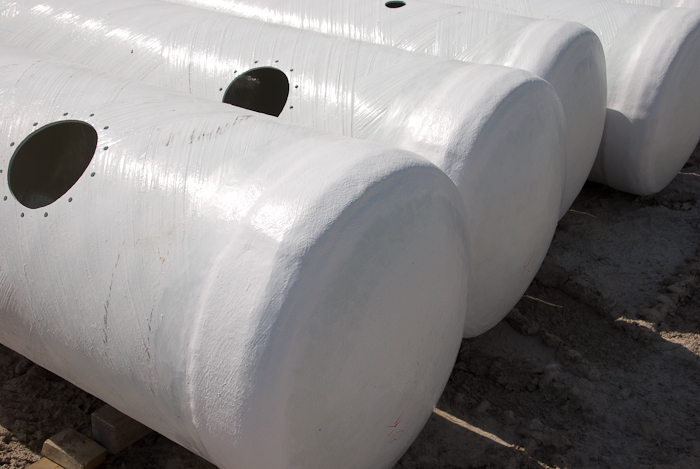
Chemical Handling: Corrosion Resistant Tanks and Vessels
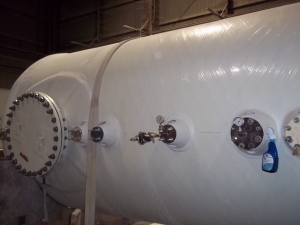 FRP are utilized worldwide for applications in chlorine, sulphuric acid, hydrochloric acid, biological transformation, fertilizer, petrochemical, and mining and mineral plants. In general terms they have been employed successfully in many chemical processes such as separation, filtration, settling (sedimentation), extraction or leaching, distillation, recrystallization or precipitation, drying, and adsorption.
In the Chemical Processing Industry (CPI) FRP are utilized to fabricate a full spectrum of products including pipes, ductwork, chemical storage tanks, absorption towers, drying towers, solvent extraction vessels, gas scrubbers, packed reaction columns, pressure vessels, process reaction vessels, stacks, process containment equipment, packing support systems, packed bed distributors, bed limiters, and distributor feed headers- to list some examples.
Each service environment is unique and requires special attention to engineering considerations. Special considerations such as concentration, temperature, pressure, vacuum will need to be addressed to ensure that the product being fabricated is optimized to enhance its performance and meet your specifications. To a large degree your service environment and specifications will influence many important design elements such as resin selection, laminate schedule and corrosion barrier.
A Short List of Some FRP Chemical Applications:
- Diammonium Phosphates
- Ammonia
- Potassium Hydroxide
- Phosphoric Acid
- Hydrochloric Acid
- Chlorine
- Sodium Hypochlorite
The corrosion barrier is typically fabricated with a resin-rich liner or corrosion barrier, followed by a glass-rich structural wall. The corrosion barrier is one component of the entire laminates schedule; it is a critical layer that must be designed properly in order to ensure effectiveness, safety and performance of your FRP product. You should always discuss resin selection with a resin manufacturer or your engineering team.
Although the corrosion liner does not provide much in terms of mechanical properties it’s extremely important to the overall design of your composite product.
Among the many products that can be fabricated from FRP are corrosion resistant tanks and vessels. Corrosion resistant FRP tanks and vessels are well known for their cost-effectiveness, long-life cycles, electrical insulation properties, high strength-to-weight ratio, dimensional stability, and their design flexibility. Furthermore, the corrosion resistance performance of FRP is exceptional when compared with traditional or common metal alloys such as stainless steel 2205 and alloy C-2706. This holds true in common chemical processing service environments—FRP performs well in hydrochloric acid and sulfuric acids—among many others.
FRP Corrosion Resistant Tank and Vessels Chemical Processing Applications
Tanks:
- Batching
- Electrowinning
- Fuel
- Plating
- Pickling
- Processing
- Recovery
- Remediation
- Storage
- Transfer
- Waste
- Effluent
Vessels:
- Solvent Extraction Vessels
- Process Reaction Vessels
- Pressure Vessels
When designed properly FRP can provide excellent high-temperature capabilities and solvent resistance. Depending on resin selection and other design factors unique characteristics may be enhanced. In general, FRP withstand many acids, alkalis and oxidizing chemicals.
The constructability and design flexibility make FRP ideal for a multitude of CPI opportunities such as plant construction, process expansions, unit and equipment additions, upgrades, conversions, modernizations, rebuilds, renovations, retrofits, debottlenecks, and major maintenance turnarounds.
 When an international client came to us needing pipes and fittings for a chlorine processing facility, we knew could help them.
 Fiber Reinforced Polymers (FRP) are well known for their abrasion and corrosion resistant properties. FRP are a composite material; they combine two or more different constituents into a one unique material; resins and fibers combine to yield a finished composite product. Fibers contribute the majority of the strength to finished product while resins provide corrosion resistance and channel stress to the fibers. There are two broad families of resins—thermosetting and thermoplastic. In the case of fiberglass and FRP we are referring to thermosetting resins.
 Fiber Reinforced Polymers (FPR), or fiberglass, is an excellent construction material. Used throughout the world in a wide range of industrial and non-industrial applications, FRP boasts cost-effectiveness, design flexibility, dimensional stability, high strength-to-weight ratio, durability, and low maintenance costs—among other things.
  April 24, 2013 marks the date of the fourth annual International Corrosion Awareness Day, started by the World Corrosion Organization; who’s mission is to promote education and best practices in corrosion control for the socio-economic benefit of society, preservation of resources, and protection of the environment.
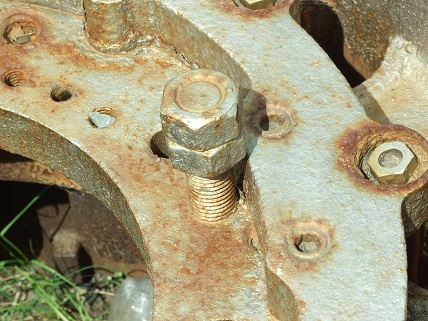 Many industries report major problems with corrosion each year. It’s a serious problem that can impact production and safety. According to the World Corrosion Organization, the estimated